When Does a Baby Eagle's Beak Turn Yellow
The Baldheaded Eagle (Haliaeetus leucocephalus) is one of the near emblematic and recognizable Due north American birds.
Most people are familiar with the advent of an adult baldheaded eagle. Nevertheless, few recognize juvenile and immature plumages that precede the impressive white-headed plumage of the developed.
This article describes the age and plumages that juvenile and immature bald eagles go through before attaining the adult plumage.
Familiarizing with these stages will help you identify and age the oft confusing juvenile and immature bald eagles.
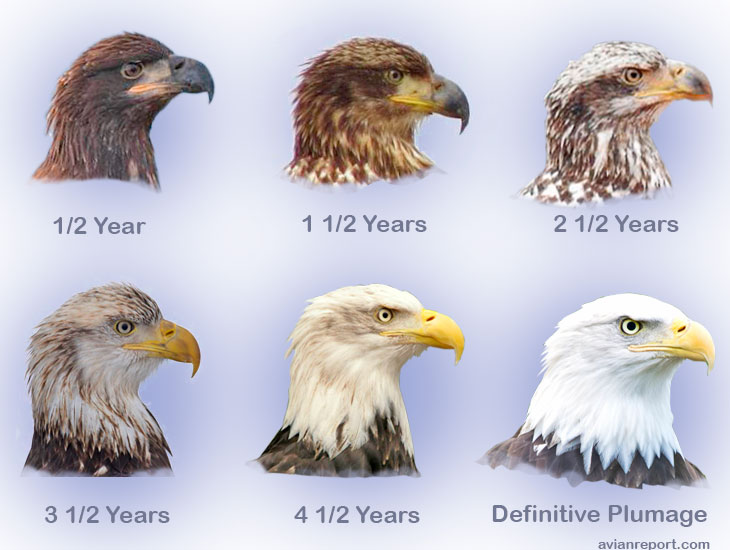
- The highly variable plumage of young bald eagles
- Do adult male and female person baldheaded eagle take the aforementioned feather?
- Classification of immature baldheaded eagles by age and plumage
- Juvenile to i one/2 Year
- 2 one/2 Years
- 3 i/2 Years
- iv 1/two to v i/ii or Definitive
- Do juvenile and immature bald eagles migrate?
- Habitat used by juvenile an immature bald eagles
- Juvenile and young bald eagle crisis
The highly variable feather of immature baldheaded eagles
The plume of juvenile and immature bald eagles shows a proficient bargain of variation. In fact, immature baldheaded hawkeye plumages are among the most complicated and difficult to classify amid North American birds.
Several ornithologists have attempted to depict immature baldheaded hawkeye plumages. These studies ran into the reality that young eagles' plumages varied among birds hatched in the same nest and among birds within and between regions.
The wide diversity of plume patterns among immature bald eagles makes information technology difficult to link one to a bird'southward specific age.
Ornithologist Mark McCollough (1989) studied 135 bald eagles of known age. He proposed broad categories of age and plume to allocate immature baldheaded eagles through connected observation over multiple years.
This article is broadly based on McCollough's work.
What are juvenile and young baldheaded eagles?
The terms juvenile and immature are oft used interchangeably. Nevertheless, ornithologists define both terms as follows:
- A Juvenile bald eagle is an individual in its outset plumage. The juvenile plume replaces the coat of downwardly while the eaglet is however in the nest.
- An young or sub-adult bald eagle is an individual older than one year that has replaced the juvenile plumage for an immature feather.
Do adult male and female bald eagle take the same feather?
A question oftentimes asked is whether female bald eagles also have white heads.
Yes, both male and female person adult bald eagles have white heads and look alike. The just deviation between adult birds is the size.
While there is a practiced deal of variation in size throughout its range, overall, females bald eagles are 25% larger than males.
Telling the sex of an adult baldheaded eagle can be difficult when a bird is alone. When mated pairs perch next, the size difference between sexes is noticeable.
Male and female person measurements
Weight: 6.6 – 14 lbs
Length: 31 inches (head to the tip of the tail)
Wingspan: 5.9 – 7.5 ft. (Adult)
Lifespan: 20 years (In the wild)
Speed: 75 – 99 mph (Diving)
Male and female birds look alike, but the females can be up to 25% larger.
How most young eagles?
There announced not to exist any difference in plume amongst immature birds. All young bald eagles appear to follow similar changes in plumage with historic period and, whether male or female, larn the definite plumage at about the same time.
Classification of immature bald eagles past age and plumage
Juvenile to one i/2 Year
Juvenile bald eagles leave the nest with a nighttime brownish plume. This plume is the darkest and to the lowest degree variable of all the subsequent young bald eagle plumages.
Fledging juveniles keep this plumage for most six months before get-go to molt into another plumage. The coloration of bare parts (neb, face, legs, and feet) besides begins to change after the starting time six months after leaving the nest.
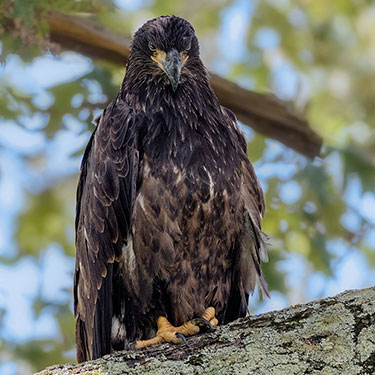
A first-twelvemonth eaglet is entirely dark dark-brown with white flecking on the wing's underside, axillaries, and abdomen.
This is the plumage an eaglet leaves the nest in.
The juvenile baldheaded eagle's plumage is the least variable amidst al immature plumages.
Fledgling birds show a blackish-chocolate-brown breast that may contrast with the lighter-colored belly.

Afterward vi months, the young eagle begins to turn lighter brown.
More white flecking begins to appear on the breast and the underwing.
The beak and cere are blackish gray.
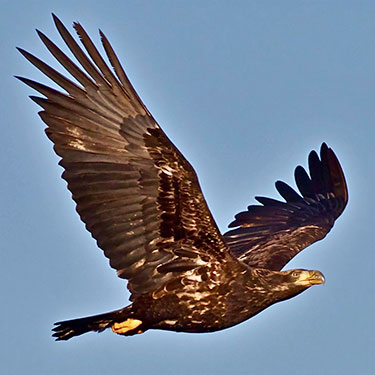
Past the cease of the outset 1 1/ii yr, the beak begins to turn colors, only this is variable with some birds keeping their dark beaks well into the 2d year.
In flight, a i ½ yr-old hawkeye may show an increasing but variable amount of white flecking.
The wings of a first-year bird are wider and have a more "rounded" trailing edge.
2 1/2 Years
The 2 ½ years of age includes some of the most variable plumage stages of young baldheaded eagles. Some birds can remain relatively dark with white flecking, while others can have a mostly white belly with brown flecking.
The plumage pattern combinations in between can be confusing and useless to age an immature bald hawkeye other than saying that the bird is about 2 ½ years of age.
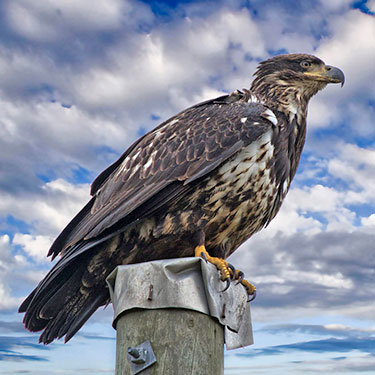
A relatively common field marking during this historic period period is a night breast that contrasts with a paler throat and abdomen.
The legs as well become more yellowish.
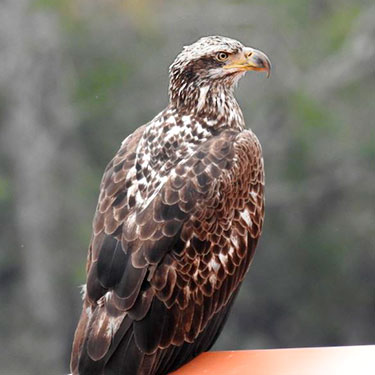
Another field mark is a whitish inverted triangular patch on the curtain.
The eyes (iris) continue turning lighter dark-brown.
The bill begins to turn yellow-brownish.
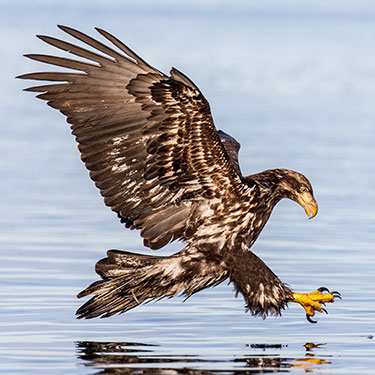
During the immature phase, the design and amount of white flecking and mottling are rather variable making it hard to tell the age of the young bald eagle.
Some birds show a whitish tail with what appears to exist a brown terminal tail band.
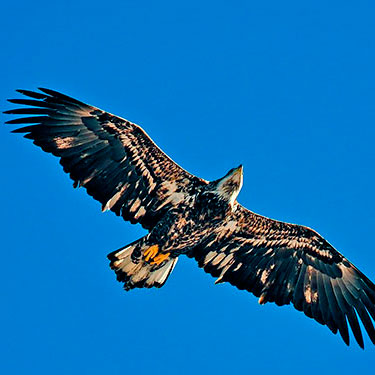
In flight, a ii ½ year-old bird shows heavy white flecking and mottling on the underwings, the back, and abdomen. Some birds bear witness a dingy white belly.
Some birds show a jagged trailing edge resulting from old and new shorter wing feathers.
3 ane/2 Years
The twelvemonth iii ½ marks the transition to the typical adult plumage. The white mottling of the underwing coverts and belly begin to darken while the head and tail begin to turn white with much chocolate-brown flecking.
Some ornithologists call 3 ½ year-old birds sub-adults.
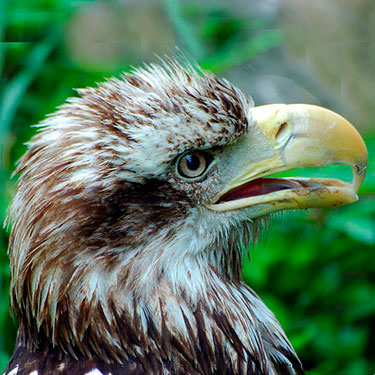
At 3 ½ years-old, the caput and tail begin to plow white brown flecking.
An important field mark of Sub-adult baldheaded eagles is a conspicuous dark ring or patch through and behind the center.

The bill is mostly yellow. Some individuals show brown streaks or lines on the culmen or top of the beak.
The eyes (iris) are low-cal brown but not nearly as pale every bit in an adult bird.
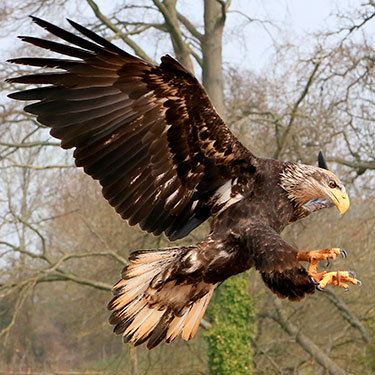
In flight, a 3 ½ year-quondam bird resembles an adult with a dingy white head and tail.
The contour or body plumage turns increasing homogenously nighttime brown.
4 1/2 to five 1/two or Definitive
During the 4 ½ to definitive plumage period, bald eagles acquire the adult plumage. The head, neck, and tail, and upper and undertail coverts turn white, and the torso turns dark dark-brown.
A 4 ½-year-onetime bird may notwithstanding show a few brown flacking on the tail and head, which are progressively lost.
Only approximately 25% of the birds acquire the adult feather at the age of 4 ½ years, but all or 100% of bald eagles larn the pure white head and tail adult plume at the historic period of 5 ½ years.
Once a baldheaded eagle acquires the adult plume this is kept throughout the life of the bird.
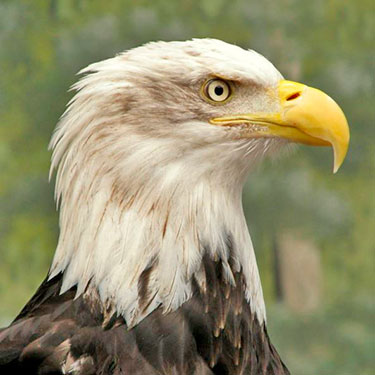
The caput acquires the pure white only may show some dark-brown flacking. Some birds take up 8 years to acquire a pure white head and neck, but nearly practise it in 5 ½ years.
The bill is at present bright yellow.
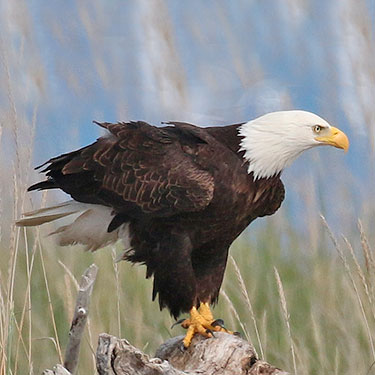
The eyes (iris) are yellowish-white. The legs become bright yellow.
The tail turns overall white but nonetheless may show some brown flecking, in some individuals.
Some birds take a few more years to larn a pure white tail and tail coverts.
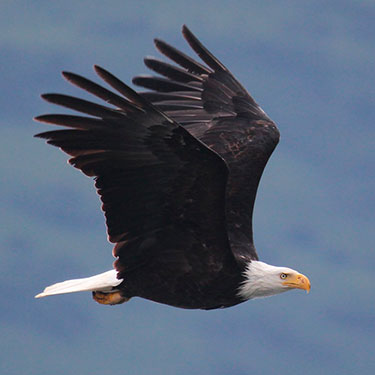
In flying, a 5 ½ yr-onetime bird shows the adult bald eagle feather.
While the head, neck, and tail may still bear witness some brown streaks, these are just noticeable at close range.
Practise juvenile and young bald eagles drift?
Juvenile and immature bald eagles disperse from their natal territories in a somewhat complex manner; without a anticipated direction or distance from the nest. They are also largely nomadic
Bald eagle biologists indicate that juvenile and immature bald eagles are largely nomadic because they practise non hold convenance territories and are non tied to a item area.
The availability of food affects bald eagles of all ages and is often linked to weather conditions. In cold winters, bald eagles mostly move south in search of better foraging opportunities. Some birds return to their territories when conditions weather condition improve, and others return simply to breed.
Near adults bald eagle, generally, do not migrate. Even so, they volition perform local and regional movements in response to the availability of food.
Migrating Patterns of immature bald eagles
Baldheaded eagles in Alaska and the Pacific Northwest follow the salmon migration moving in the salmon'southward direction where dead fish is readily available.
Eagles breeding in Canada and the Northeastern U.Southward. drift along with feeding areas on the Atlantic coast. However, many birds stay in their territories as long equally lakes, rivers, and other water bodies are however available.
Juvenile and young birds from Florida move north along the Atlantic coast, while others migrate onto the Cracking Lakes region.
Habitat used by juvenile an young bald eagles
Juvenile bald eagles remain associated with their parents for 4-x weeks after fledging. Some immature eagles depend entirely on their parents for nutrient during the get-go 4 weeks subsequently leaving the nest.
One time the immature bald eagles become independent, they feed on dead fish or carcasses. They are unable to catch live prey for about the first 6 weeks later they leave the nest. Juvenile bald eagles are opportunistic, eating mostly dead fish.
Over time, juvenile birds, begin learning to catch live prey, which expands the habitat types they can use.
Three-year-former young bald eagles begin frequenting areas with concentrations of waterfowl where they use and refine their hunting skills alongside experienced adults.
Overall, adults and young bald eagles employ largely the same habitat, specially when nutrient is abundant. Conversely, when food is scarce, adult birds employ prime areas, relegating younger birds to marginal foraging areas.
Juvenile and immature birds are noted for staying longer around carcasses or accumulations of dead fish.
Juvenile and immature bald eagle crisis
During the early 1970s, the bald eagle population experienced a steep decline due to Dichloro-diphenyl-trichloroethane's widespread use.
Seeing juvenile and immature eagles during the 1970s was a rare event. This was considering the components of DDT interfered with female baldheaded eagles' ability to produce eggs with thick-enough shells.
Most nests failed because the eggs would hands break with merely the gentle weight of an incubating adult. Very few juveniles were produced every twelvemonth.
On what is at present a successful conservation story, the Baldheaded Eagle has regained numbers and continues to recover to the point that it is at present adequately common in certain areas.
Bald eagles are now seen most bodies of h2o and sitting on utility posts and other places.
Last Remarks
I hope this article helps you tell the approximate age of the next juvenile or immature hawkeye you see. Knowing the gauge age of a baldheaded eagle will help you have accurate notes.
If you lot tin recognize private birds in your area and encounter them over the years, you can certificate the plumage changes equally they become adults.
Related: Bald Hawkeye Eggs: Appearance, Egg-Laying, Incubation, and Egg-Hatching.
References:
- Buehler, D. A. (2000). Bald Hawkeye (Haliaeetus leucocephalus), version 2.0. In The Birds of North America (A. F. Poole and F. B. Gill, Editors). Cornell Lab of Ornithology, Ithaca, NY, USA.
- McCollough, G. A. (1989). Molting sequence and crumbling of Baldheaded Eagles. Wilson Bulletin 101:1-x.
LEARN More:
Source: https://avianreport.com/age-and-identify-a-juvenile-and-sub-adult-bald-eagle/
0 Response to "When Does a Baby Eagle's Beak Turn Yellow"
Post a Comment