how to help your 5th grader understand what operation to use with fraction story problems
By Steph Primiani, Director of Stem and Alicia Cuomo, Brownish University Urban Education Policy Intern
Which of these math problems makes more sense to y'all?
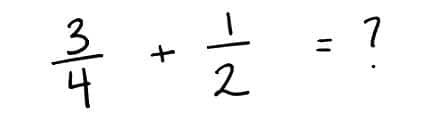
Combine 3/4 and 1/2.
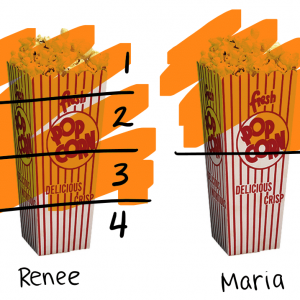
Renee eats 3/4 bag of popcorn. And then Maria eats one/two bag of popcorn. How much popcorn did Renee and Maria eat altogether?
Both issues require the aforementioned skill–finding equivalent fractions to combine two numbers with different denominators. Just, the popcorn question provides a realistic context for why.
"Teaching through trouble solving might be described as upside downward from education for trouble solving—with the trouble(s) presented at the beginning of a lesson and skills emerging from working with the problem(southward)." 1
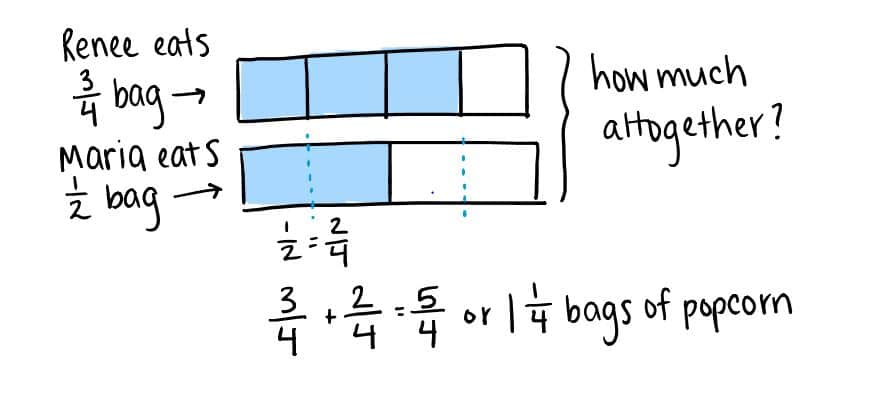
The narrative structure of the story problem question invites students to create a model with labels. Within a discrete fraction model , students partition to discover the equivalent fraction:
Within a number line model , the popcorn story is more explicitly visualized as a series of events, the last jump existence the sum:
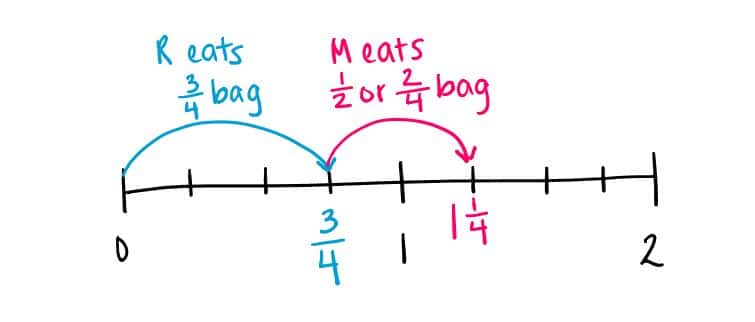
By creating a model to combine the portions of popcorn, students are guided to discover the procedure for finding equivalent fractions. Further, they immediately know one realistic context where a mathematical skill can be applied, and students tin more than easily discover patterns in problem types to use more than efficient strategies and solve increasingly complex scenarios.
The Problem-Based Classroom
In a 2006 conversational interview, mathematics professor and author John A. Van de Walle stressed the need for all American classrooms to norm a trouble-based approach led past the ideas of students rather than teacher-directed lecture. When the instructor is lecturing in a show-and-tell approach, Van de Walle argues that students are focused on the directions and rules rather than the mathematical concepts.
With a problem-based approach the educatee has nowhere else to plough other than his or her own ideas as they relate to the trouble. As a result, rather than looking for rules, students endeavour to brand sense of the relevant ideas imbedded in the problem or job . Even if a problem is non solved, their ain relevant ideas have been engaged. The class discussion that follows will be meaningful and interesting. Ideas are developed and integrated with each learner'southward existing understanding.
For me it is as well extremely important to consider what each approach is maxim every twenty-four hour period to students. With teacher-directed, wonderful explanations, students often view mathematics as a collection of rules that often get confusing and accept little meaning… In the trouble-based classroom students…experience the most basic fact of mathematics: math makes sense. Further, they come up to realize that they are the ones who are capable of making sense of mathematics. ane
The 20-minute Math Stories protocol is a educatee-centered approach that does just what Van de Walle suggests–forces students to independently make sense of challenging problems in realistic contexts. How tin can teachers leverage context in Math Stories and during their cadre instructional block? Why does context matter in a student-centered approach?
Non-Routine Problem Solving
Function of Van de Walle'due south vision is that mathematics is not about existence able to identify problem types and apply straightforward algorithms. Rather, problem solving in mathematics is non-routine.
Definitions of problem solving vary beyond curricula, but in essence they are not-routine questions that can be solved using more than than one strategy . "Learning multiple strategies may help students see dissimilar ideas and approaches for solving problems and may enable students to call up more flexibly when presented with a trouble that does not accept an obvious solution."
The 5th grade Math Stories sequence has approximately 70 story bug. It is a carefully scaffolded progression that begins with a review of 4th course concepts, then a couple months in, students motility into fifth class fraction standards using all iv operations. There are mostly 10-13 story problems a month, which gives teachers the flexibility to spiral challenging problem types and revisit concepts.
What's key most the daily story problem is that information technology presents a mathematical challenge in context . Providing context is crucial to supporting students in sense-making and flexible trouble solving. Further, story bug support students in developing skills in three areas RAND (a huge nonpartison enquiry corporation) has deemed necessary for edifice proficiency:
- Representation
- Justification
- Generalization
Supporting Student Independence
Whereas students may be primed to place the trouble type in an explicit lesson and follow a familiar procedure, in Math Stories, students aren't given any data in addition to the story problem. As Van de Walle suggests, this hands-off structure forces students to think well-nigh what information they already know and what they are being asked to solve for. Theoretically, this sounds great, simply in classrooms students accept varying needs, are still developing metacognitive skills, and are often quick to skim issues and rely on straightforward algorithms.
How do we train students to read story problems carefully?
The Checklist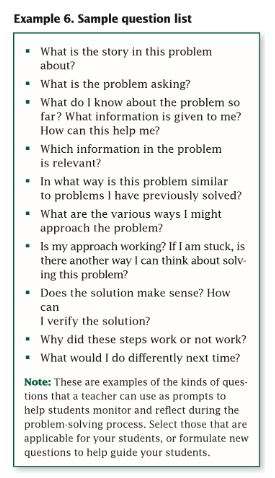
A question list can support students in reading a story trouble thoroughly for known and unknown information. The What Works Clearinghouse (WWC) is funded past the Institute of Teaching Science (IES) through the U.Southward. Section of Instruction and is a huge resource of pedagogy enquiry. Here is WWC'south sample list of prompts:
Model Self-Monitoring and Reflection
Teachers should model how to use prompts like the ones listed above to reason with oneself throughout the problem solving process–when reading the story problem, choosing a strategy to solve, and checking your work. Students acquire from example how to think aloud to themselves when solving a story problem. Here is an example from WWC, adapted to Math Stories, of a pupil self-monitoring. The student asks and answers a sequence of questions that'due south the same no affair the trouble type:
Example Problem
v friends are planning on splitting 3 pizzas evenly. One of the friends tin't come to dinner anymore. How much more pizza will the friends get if only 4 people split the pizzas instead of 5 people splitting the pizzas?
Solution*
Student: First, I ask myself: "What is the story about, and what practise I need to find out?" I encounter that the problem has given me the total amount of pizza and two different scenarios for sharing the total amount of pizza. I know that "how much more than" is request me to compare, or subtract, the difference between how much pizza each friend gets in each scenario.
I ask myself, "Have I seen a problem like this before?" As I recollect dorsum to the story problems we've washed, I remember seeing a problem where friends were sharing a pan of brownies. I think we had to separate the whole by the number of friends to become each friend'south portion. This seems like a similar kind of problem, but I'm going to accept to split twice because there are two scenarios and then compare.
Before I go on, I inquire myself, "What steps should I take to solve this trouble?" Information technology looks like I need to divide the total corporeality of pizza by the number of friends for each scenario.
4 friends: 3/5 pizza per person
5 friends: ¾ pizza per person
The problem is request me "how much more" pizza the friends become when there are but 4 people splitting instead of 5. I know that when I'm comparing, or finding a difference, I tin utilise subtraction. But, I have to have the same units to subtract.
I can use my model:
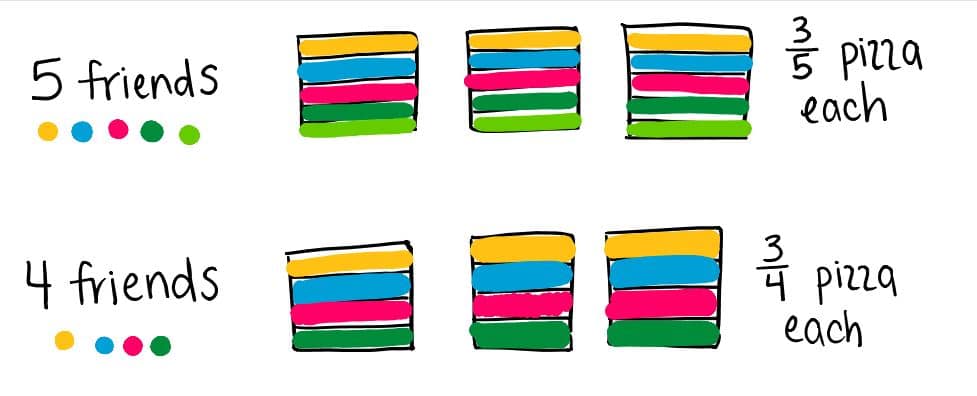
To write an equation:
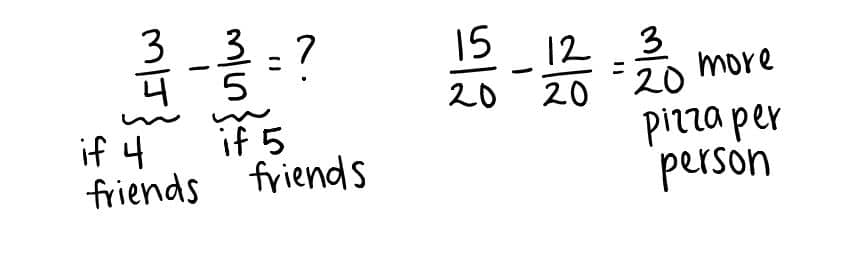
Then, the difference is iii/20. The friends each get 3/twenty more than pizza when there are only 4 people compared to when there are 5.
Finally, I ask myself, "Does this respond make sense when I reread the problem?" It makes sense to me that 3/xx is the answer because it's the difference betwixt the portion size for 5 friends and 4 friends. three/20 is a small number compared to the portion sizes. (I know 3/10 is the same as 0.3 or 3%, and three/20 is even less!) This makes sense because the problem is asking me to find the difference—taking abroad 1 friend makes a small difference in how much pizza each person volition get.
Back up with Unfamiliar Language and Contexts
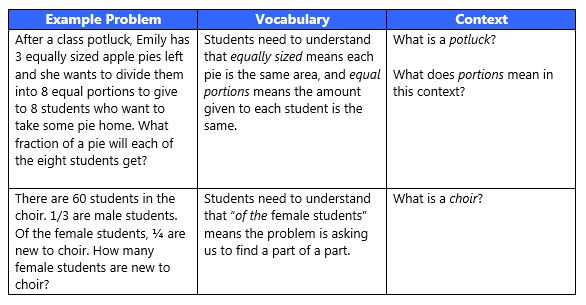
It is certainly true that students will encounter unfamiliar language and context on formal assessments that they will have to grapple with without the help of a teacher or peers. However, every bit WWC states: "The goal of ensuring that students empathize the language and context of problems is not to make problems less challenging. Instead, information technology is to allow students to focus on the mathematics in the problem, rather than on the demand to learn new background knowledge or language. The overarching point is that students should empathise the trouble and its context earlier attempting to solve information technology." For this reason, it's important for teachers to anticipate when the fifth graders in their grade may demand additional clarification, peculiarly English language language learners. Here is an case adapted from WWC using Math Stories story problems:
Personalize Story Problems
WWC and other research suggests students are more engaged and can brand connections to the real life applications of math when story problems are personalized. Teachers should exist careful not to do this all the fourth dimension– students need to become used to thinking almost scenarios outside of their comfort zone. Simply, sometimes including students' names, dear trends like beyblades, and having scholars come with their own scenarios, can heave engagement. Each story problem in Math Stories is standards-based, so information technology's elementary to swap out the content for content that's relevant to your classroom while still teaching key concepts.
Resources
i (2006) A Conversation with John Van de Walle, writer of Elementary and Middle School Mathematics: Didactics Developmentally.
2 RAND. (2003) Mathematical Proficiency for All Students: Toward a Strategic Research and Evolution Plan in Mathematics Education.
Have questions? Reach out to BVP'due south Director of STEM, Steph Primiani at sprimiani@blackstonevalleyprep.org and follow me on Twitter @stephprimiani
Source: https://blackstonevalleyprep.org/tackling-5th-grade-fractions-through-math-stories-part-15/
0 Response to "how to help your 5th grader understand what operation to use with fraction story problems"
Post a Comment